




 Indietro


















A harsh reality for today’s enterprise help desks
Leaders and agents running enterprise help desks today are in a very tough spot. They are tasked with resolving a dramatically increased volume of tickets, yet lack the visibility and tools needed to do so.
Overwhelmed and often unable to do their jobs effectively, help desk professionals inevitably fall back on guidelines and rules of thumb that are simplistic and don’t reflect the complexity of a hybrid, digital workforce. Time is then wasted trying remedies that don’t produce results.
This environment leads to many repeat tickets and frequent escalations–with predictable results: low user satisfaction, high help desk turnover, and frustration for all involved.
The help desk dilemma in numbers
This dilemma has negative impacts on workforce productivity and help desk efficiency. Employees are frequently either slowed down or stopped in their tracks by tech issues. Nearly all workers (95%) experience business-critical app performance issues at least once a week.1 Employees lose one day per month of productive time due to digital friction.
Meanwhile, help desks also take hits in their inability to efficiently solve issues. One in three organizations say they have less than 50% first-time resolution rates (FTR)2, and it takes longer to diagnose an issue than fix it. This places root cause visibility on the critical path.
Help desks would love nothing more than to increase first call resolution and user satisfaction, and to reduce mean time to repair (MTTR) and ticket escalations. Yet, they lack the visibility and tools required to make these positive changes.
Help desk challenges
This situation exists because of factors inherent to a post-pandemic digital workspace. Some specific challenges, highlighted here, explain why 66% of IT professionals say they cannot support future hybrid and remote work needs with existing levels of help desk visibility across the digital workspace infrastructure.3
Workload
Although many enterprises have doubled help desk head count, tickets have increased twice as fast. Commonly prescribed solutions to this problem–including outsourcing and automation–can only partially close the gap. Hiring can’t keep up, outsourcing increases resolution time, and automation is a slow fix at best.
Misguided efforts
User-reported symptoms rarely provide enough context or details to accurately postulate the fault domain. Lacking the tools to dig deeper, help desk personnel are forced into misguided actions that waste time. Despite the best efforts of help desk agents, half of level one cases are escalated and require two or more teams to diagnose4, and 20% of issues are never closed because they cannot be diagnosed or resolved5.
The ping-pong effect
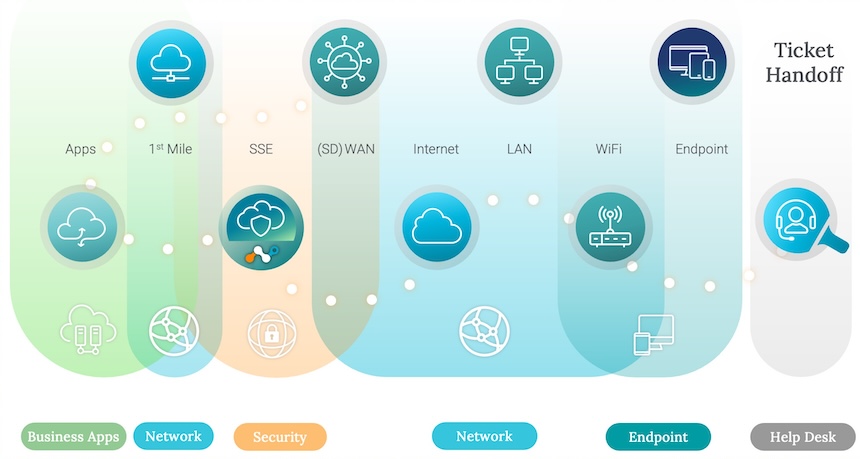
The life of a modern help desk ticket unfortunately most resembles the path of a ping-pong ball–bouncing from one troubleshooting group to another.
It starts when a level one help desk lacks the ability to identify problem origin or solve the issue. The agent working a case then (often incorrectly) re-assigns the ticket to another group. Nearly half of cases (46%) get escalated–32% immediately, and another 14% after agents are unable to collect sufficient additional information from the end-user6.
The story doesn’t end there: each group assigned to the case seeks to prove innocence before passing the ticket on to another team. Rinse and repeat. No wonder so many cases spawn repeat tickets, or just never get solved at all!
The crux of the matter: lack of visibility
In short, closing tickets is a slow and painful process when the origin is unknown–a situation caused by lack of visibility.
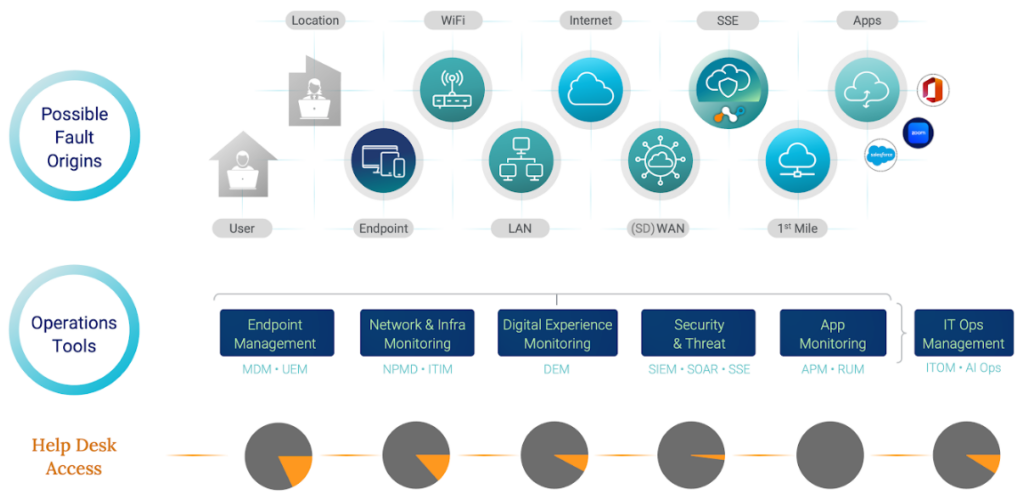
Even the most experienced level one help desk staff lack access to tools and data beyond simple traffic flow analysis, latency monitoring, or down detectors. Without visibility across domains, help desk professionals make inaccurate assumptions about which issues predominate, where problems originate, and who is affected. In a nutshell, they can’t accurately triage and resolve issues.
Two examples:
- Devices and WiFi account for about 30% of issues7, but help desks tend to assume they are among the top sources.
- At least one-third of tickets are reassigned more than once–evidence that the assumed root cause was incorrect8.
Making matters worse, it’s often hard or impossible to pinpoint the cause and identify who is responsible for fixing issues involving third-party and cloud apps/services, since visibility into these areas is missing.
Proactive digital experience management for help desks
All this sounds, and is, dire. Yet, within the constraints of modern help desk environments, it is possible to close visibility gaps that lead to inefficient guesswork, repeat tickets, high turnover, and unhappy users.
Proactive digital experience management provides simple but comprehensive visibility into all common fault domains, early in the ticket process. This leads to swift diagnosis and fast repair time, often at level one.
Footnotes
1 – IDC, 2023
2, 3 – Forrester survey, 2021.
4, 5, 7 – Netskope survey of IT Ops leaders, 2024
6, 8 – Netskope global service desk survey, 2024


 Leggi il blog